
Alpine Wine
Italy’s Trentino-Alto Adige/Südtirol wine region is actually a duo of regions. Bumping up against the Italian peninsula’s northern border with Austria (with the Adige river running north and south through it) the southern half is Trentino, while the northern half is the Südtirol — the culture that one emperor and two fascist dictators failed to wipe out.
The Tyrol
For 550 years, Tyrol was a southern county of the Austro-Hungarian Empire. Its lower part was called South Tyrol (Südtirol) and extended into what is now Italy. Although, it did gain another name in the early 1800s …
That Controlling Napolean
In 1810, the area fell under the rule of France as part of the Napoleonic Kingdom of Italy. Napoleon, wanting to eliminate all elements of former Hapsburg control, demanded that the region be renamed Haut Adige (“Upper Adige” — or ”Alto Adige,” in Italian). This policy lasted until his defeat in 1815, when Südtirol went back to the Austro-Hungarian Empire. It stayed a part of the Hapsburg Empire until the end of WWI. At war’s end, Italy was occupying the region, and when the Treaty of Saint-Germain-en-Laye was finalized in 1919, they had full recognized ownership of an area full of German-speaking, former Austro-Hungarian citizens.
That Meanie Mussolini
After Mussolini came to power in 1920, he let loose his cultural homogenization obsessions (as fascists tend to have) on Südtirol as part of his campaign of “Italianization” — forcibly culturally assimilating native populations and the annexed Austro-Hungarian regions. He made Italian the official language, replaced all street and place signs with Italian versions, and encouraged southern Italian settlement in the area. (Südtirolians formed secret German schools to keep their language spoken.) When Mussolini made an alliance with Nazi Germany, Hitler got in on the act. Under the 1939 South Tyrol Option Agreement, all Südtirol Austrians had to either emigrate to Germany or fully assimilate to Italianization.
The onset of WWII, however, gave both dictators other people to crush, and the Option Agreement was never fully enforced. After the end of that war, the Republic of Italy declared both German and Italian to be official languages of the region. That’s why you see the dual name Alto Adige/Südtirol (even though, an overwhelming percentage of the population still speaks German). Over the following decades, Südtirol gained increasing amounts of autonomy from Austria and within Italy, culminating in an Austro-Italian treaty in 1971.
But, you’re not here for geopolitics. You’re here for wine.
A River Runs Through It
The Adige river has formed valleys down the length of the Alto Adige/Südtirol region, and most of its vineyards sit in those alluvial soils. In the summers, the valley floors get a lot of Alpine sunshine and fill up with warm air. Thus, the vineyards there are able to produce much riper grapes than you would expect from a cool, northern region.
Formerly known for its wines made from local red grapes like Lagrein and Schiava, today Alto Adige/Südtirol gets a lot of attention for its whites. Look for German grapes like Müller-Thurgau and Sylvaner as well as grapes like Sauvignon Blanc, Pinot Bianco, and Pinot Grigio.
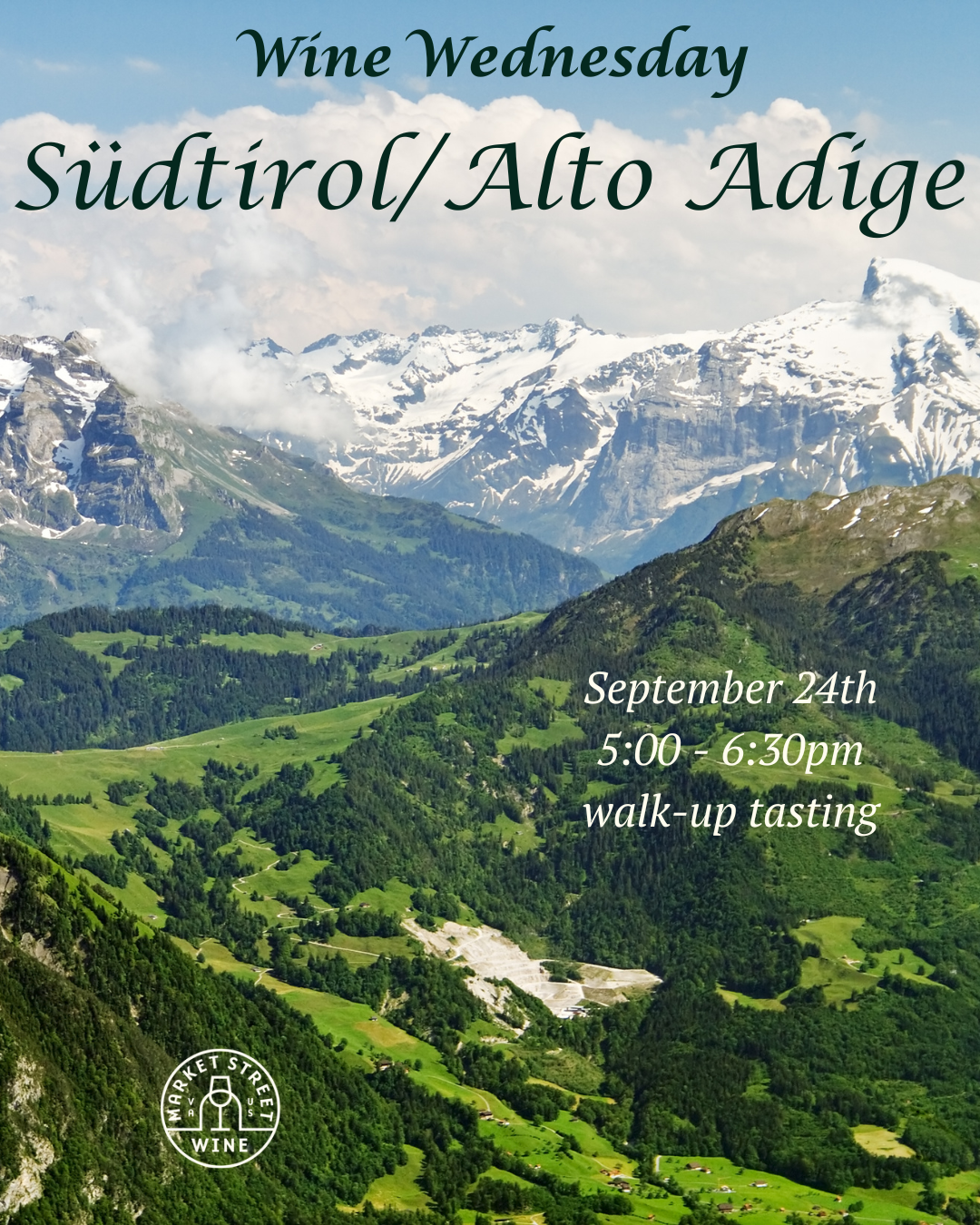
This Wine Wednesday, join guest pourer Kristen from distributor Winebow Fine Wine + Spirits for a sampling of Alto-Adige/Südtirol wines (plus a Chianti thrown in just for fun!). Please stop by anytime between 5:00 and 6:30 PM for some Alpine wine.