
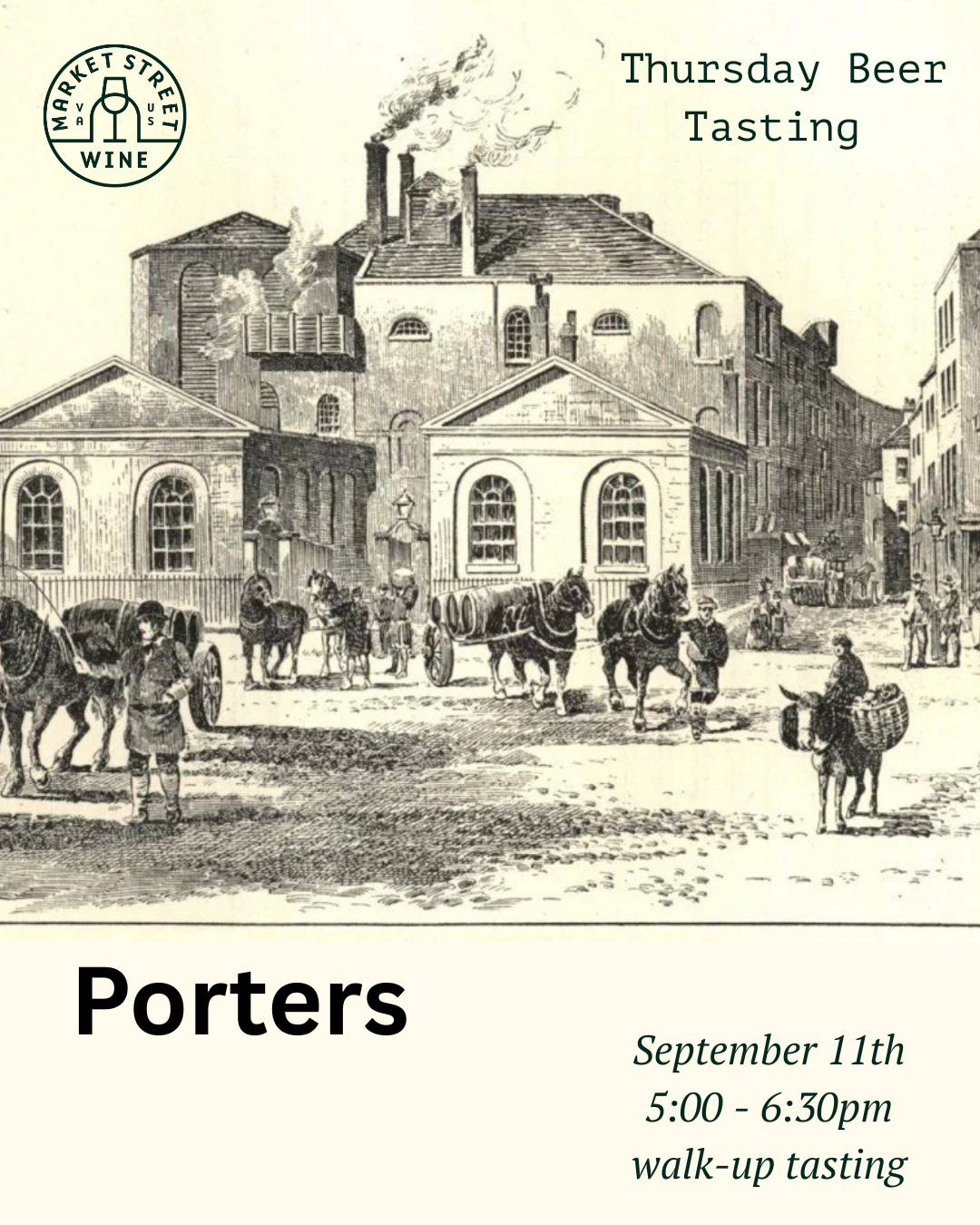
The Great London & American Style
There’s probably no beer style with more legends about its origin than the Porter. We’ve certainly told and re-told some over the years. We’ve read accounts that say that its popularity was linked to the rise of railroad travel. We’ve read that it was meant to be a replacement for a blend of three different types of ales. We’ve read that it was the result of mechanical developments from the Industrial Revolution. The most credible sounding account we’ve run across is from a British beer blogger.
So, the scene is the early 1700s in London. People are still drinking a mix of beer and ale. (For the difference, see last week’s event write-up.) On top of that distinction, at this time, there was also a distinction within London beer between fresh beer and aged beer. It was popular to blend ales and different beers together, and, as we said above, many beer wags (us included) learned that the Porter developed as an alternative.
This blogger makes a good sounding argument that rather than that origin, porters were a development of the London Brown Ale. Competition from other beers drove London brewers to improve their recipes. Thus, by the 1740s, increased hopping and aging led to the development of a brown ale that was a step above its ancestors. More expensive than fresh beers but less expensive than aged beers, the new browns became popular among London workers - the porters who were carrying goods here and there. The beer then took the name of its fans — probably first “Porter Beer” and then just “Porter.” Once the steam engine allowed for the mass production of beer in the 1760s, the Porter was poised to benefit from that development.
Though porters became hugely popular in the 18th and 19th centuries, their popularity did not survive post the World Wars. After WWII, London brewers brewed porters considerably weaker than they had before and even during the wars. Post-war porters were so weak that drinkers switched over to stouts, which were still made with some kick. By the 1960s, the Porter — once overwhelmingly popular — had pretty much disappeared in Britain. However, it did not vanish completely from the world stage …
First, a variant was enjoying a life in the Baltic regions, and next, in 1972 San Francisco, Anchor Brewery brewed its first beer other than its legendary Steam Beer … a porter. That’s right, among its many firsts, Anchor brewed the first commercial American Porter. More were soon to follow, though, because in 1978, distributor Merchant du Vin began bringing European beer into America. One of its first breweries was Samuel Smith’s Old Tadcaster Brewery from Yorkshire, and in 1979, Samuel Smith released their Taddy Porter. Why? We don’t know. However, due to Merchant du Vin’s distribution, the Taddy Porter got more exposure in America than Anchor’s porter, introducing the style to scores of budding craft brewers. Thus, by the time the Craft Beer Revolution kicks in 10-15 years later, it was common for that first round of craft brewers to have their Porter among their lineup. Amazingly, the Porter style had a resurgence here, across the ocean.
History aside, we love a porter. We always have. Even if Climate Change September temperatures don’t quite support them yet, this week’s beer tasting, we will revisit our porter collection. Please join us any time between 5:00 and 6:30 PM.